
How Elgin Freed Up Staff for Pipe Replacement by Handing Off Resident Testing
LSL Replacement
Sampling
Communications
.png)
Illinois regulators handed Elgin an aggressive lead service line replacement mandate, then asked the city to run resident testing and filter delivery on top of it. Elgin found the second team it needed in 120Water.
The Challenge
Between 2021 and 2022, state and federal regulators arrived in Elgin, Illinois, with an inspection and a list of requirements. Lead levels in homes served by lead service lines (LSLs) were too high, and roughly 13,000 to 14,000 of Elgin's 34,000 service lines were made of lead. The list of what had to happen next was long: a corrosion control study, an accelerated replacement schedule of 7% of the city's LSLs every year, filters delivered to any affected household on request, and lead testing for the residents living behind those pipes.
Nora Bertram, Elgin's Water Director, watched two demanding jobs try to fit inside one department. There was the corrosion control work. There was a replacement pace the city has now exceeded every year since it was set. Layering resident testing and filter logistics on top of both, she said, was “going to be adding on another level of complexity” her staff couldn't maintain.
Some of what Illinois required, Nora said, came before there was a federal regulation requiring it at all. Elgin was managing an intensive compliance load with less precedent from other utilities to lean on than a city facing the same requirements today would have.
The Approach
The fix arrived through a batch of marketing materials Elgin's previous water director had received from 120Water. He recognized what 120Water did and pointed the city toward it. Bringing 120Water on let Elgin's own staff put their hours into the parts of the mandate the city couldn't hand off: LSL replacement, the corrosion control study, and public education and outreach.
Elgin didn't hand off everything. Crews still hand out filters themselves during service line replacements and meter change-outs, a scaled-down version of the same job, kept in-house because it overlaps with work the city was already doing on-site. The higher-volume testing and filter program is 120Water's, and it was busiest in the effort's early years, tapering as more lines got replaced and more residents were already tested and supplied.
Putting a third party in front of residents was never a hard sell internally, either. Nora said no one raised concerns about it: 120Water's staff are trained for the work, and the city stays reachable if anything needs to be escalated.
The Outcome
Start with the logistics Elgin still owns today: roughly 100 compliance samples every six months, each one requiring a staff member to drive to a home, drop off bottles, come back for them, deliver them to a certified outside lab, then follow up once results are in. That is the job 120Water took over for voluntary and impacted-household testing, at a much larger scale. At its peak, Nora said, the program ran into the multiple hundreds of samples a month. Elgin didn't have staff for that volume, and it didn't have shelf space for the filters either, a second problem the partnership erased.
Two and a half years of quarterly data help explain why. From the program's early days through most of 2025, the share of tested homes exceeding the EPA's action level held in a stubborn band, sometimes near 12%, sometimes closer to 28%, with no clear trend in either direction. Then, in the first quarter of 2026, Elgin brought a new corrosion control protocol online. That same quarter, the exceedance rate fell to 0.8%. It has held near 1% since.
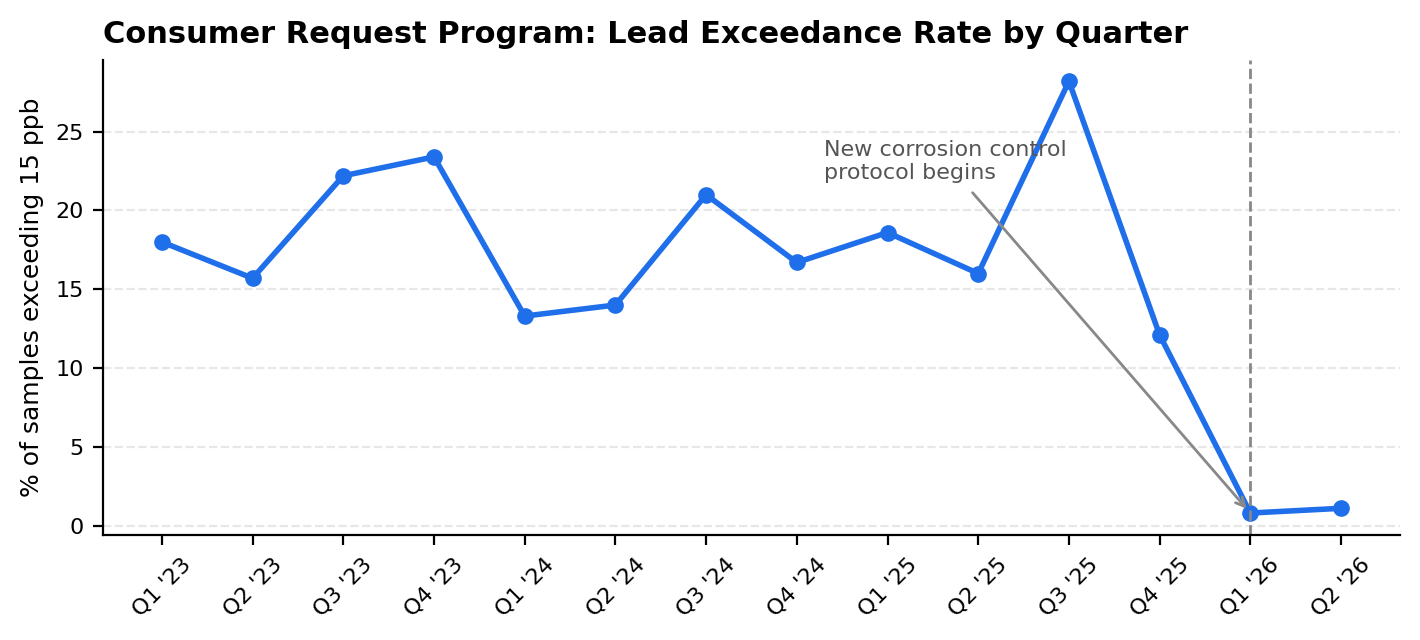
Source: 120Water Q2 2026 Consumer Request & Pitcher Filter program report.
Program-to-date through June 30, 2026, Elgin has ordered 5,329 testing kits and distributed 4,090 pitcher filters through the Consumer Request and Pitcher Filter programs, and 120Water has mailed 2,377 result letters since the programs began. The workload isn't on a steady downward slope, though. Consumer Request kit orders dipped to 105 in Q2 2026, down from 148 the quarter before, only to climb back to 207 so far in Q3 2026 after a public Action Level Exceedance (ALE) notice prompted more residents to request testing, a reminder that demand can spike around a single event, not just decline steadily as replacements wind down.
Staying Ahead of What's Next
Elgin didn't set the data aside once it had it. Quarterly reports feed directly into what Nora sends the state (filters delivered, tests run), and into the numbers she posts, anonymized, on the city's website each quarter, and unredacted, to regulators. Nora also described a public dashboard, updated weekly from 120Water's data, that lets residents check filters distributed and tests completed for themselves.
The work ahead looks a lot like the work behind it: replace lines faster than the federal deadline requires, keep corrosion control running until every lead line is gone, and keep contractors interested in bidding on Elgin's projects even as a labor shortage tightens the market elsewhere. The city's most recent monitoring period put lead levels well below where they used to sit. Elgin is still technically under an action-level threshold, which is precisely why the pace hasn't slowed.
The replacement program keeps generating its own testing workload, and 120Water runs that outreach too: a postcard about five weeks after a line is replaced, inviting the resident to request a water test. As of January 2026, that request has to be active; there's no automatic kit in the mail anymore. Elgin replaced 330 service lines in Q2 2026 alone, pushing its program-to-date total to 2,211. On the testing side of that program, Elgin has ordered 1,398 LSLR kits to date, with 22.3% completed and analyzed so far.
The Result
- 2,468 lead service lines replaced program-to-date, at a pace that has exceeded the state's 7%-a-year minimum every year since it was set.
- A corrosion control study (computer modeling, harvested pipe scale analysis, a pipe loop study) now fully implemented; the exceedance rate for lead fell from a range of roughly 12% to 28% to near 1% within two quarters of the new protocol going live.
- 5,329 testing kits ordered and 4,090 pitcher filters distributed program-to-date, through a program 120Water runs so Elgin's own staff don't have to.
- A separate post-replacement testing track for the LSLR program: 1,398 kits ordered to date, with 22.3% analyzed so far.
- A public dashboard, refreshed weekly, giving residents their own window into filters distributed and tests completed.
- Quarterly, ready-made reporting that goes straight to state regulators and the city's own website.
Looking Ahead
Ask Nora what she'd tell another utility eyeing a similar handoff, and she doesn't start with vendors or contracts. She starts with time: the hours her team gets back by not driving bottles to houses, not warehousing filters, not building reports from scratch. Those hours went somewhere else, into the corrosion control work, into keeping the replacement program on schedule.
"It's been a weight off our shoulders to have this labor-intensive part handled by someone we trust: getting test results to residents, getting filters delivered, all of it. It's one less thing to worry about." — Nora Bertram, Water Director, City of Elgin
"For us, it was kind of a no-brainer to take those customer-service-heavy tasks we didn't have the capacity to handle in-house and have someone else handle them for us. That way we were able to meet the requirements the regulators gave us and protect the public, as was the intention."
Nora Bertram
Water Director, City of Elgin