Building Trust Within Your Community
Communications
Lead & Copper Rule

Addressing lead concerns in your community necessitates careful planning to avoid sparking panic and potential public relations crises.Water systems that proactively and effectively communicate their lead removal and remediation efforts are more likely to gain the understanding and trust of consumers and community stakeholders. Going beyond mere compliance with regulations and actively fostering confidence in utility efforts is a key step toward long-term success.The foundation of building trust rests with you. As you craft messages, engage with customers, and implement your communication strategies, do so with purpose and mindfulness.In general, LCRR requirements and drinking water are complex topics that pose a challenge to communicating with customers.

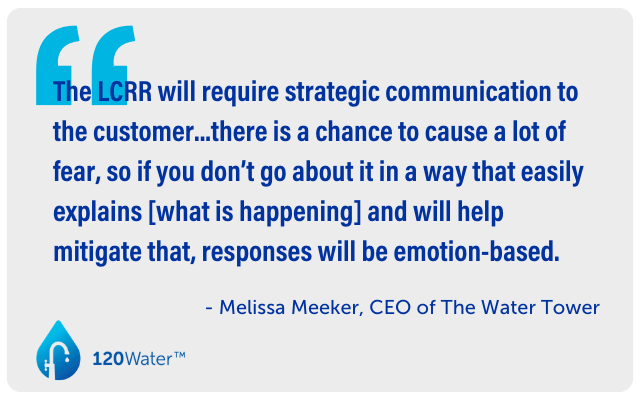
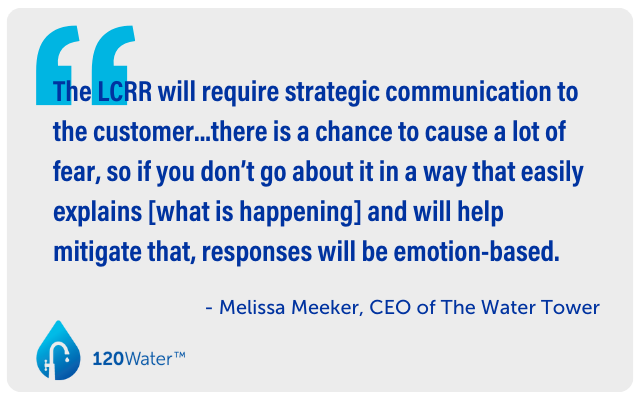
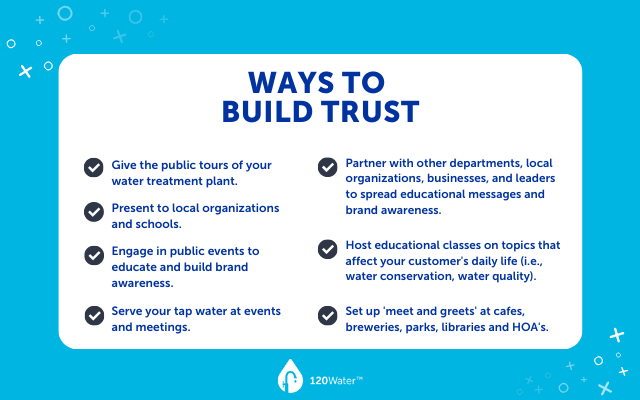
Melissa Meeker, CEO of The Water Tower, emphasizes the need for strategic communication regarding the LCRR. Failure to explain the situation clearly and alleviate fears may lead to emotional responses among the public, highlighting the importance of a well-planned approach.If you don't have a dedicated communication and outreach budget and staff, don't worry. There are many ways to build trust within your community, including the seven below.

With a little over one year remaining until the first LCRR deadline, water systems must focus on building trust within their community now. 120Water will continue to help your water system navigate the LCRR requirements, including communication and outreach. Subscribe to our newsletter to continue learning ways to engage and build trust with your community.
Insights, resources, and tips for water operators
Scott Huckaby is no stranger to the realities of small water systems. As a geologist, retired teacher, and water quality expert, he oversees eight systems across Georgia, each grappling with the same obstacles: aging infrastructure, limited funding, and increasingly complex regulations. “The systems I work with were largely installed in the 1950s, 60s, and 70s. They’re old, patched together, and expensive to maintain. Convincing local governments to invest in these systems is often an uphill battle,” he explained.One example stands out. For years, Scott worked tirelessly to convince a town council to upgrade a collapsing water system from the 1950s. “They were spending more money fixing leaks than they were earning. It took me five years of constant conversations to get them to apply for funding. But in the end, they were able to secure a loan with 60% forgiveness, and the system is finally rehabilitated.”But funding and upgrades are only part of the equation. Scott recalled an especially challenging project involving an orphanage, where decades-old galvanized lines and 50/50 lead solder created serious risks for the vulnerable population living there. “The only real solution is replacing the plumbing in every house,” he shared. “But they don’t have the funding, and there’s little help available for private systems like theirs.”
Aging Operators and the Next Generation Crisis
Beyond infrastructure, the water industry faces another looming crisis: a mass retirement of operators with no clear pipeline of new talent. At 62 years old, Scott is part of a generation nearing retirement. “I’m 62, and most of the operators I know are my age or older. The younger generation isn’t stepping in to fill these roles,” Scott noted.Scott is training one young operator in hopes of bridging the gap. “I tell him, ‘You’ll have job security for the rest of your life. Small towns will always need clean water.’ But we need to do more to attract younger people to this industry. We need programs in high schools to show them this work doesn’t require a college degree, just hands-on training and a willingness to learn.”
PFAS and the Next Frontier of Water Quality Challenges
While tackling aging infrastructure and the lead and copper rule remains critical, Scott pointed to PFAS contamination as the next big challenge. “PFAS is going to make lead and copper compliance look easy,” he said. One of the systems he oversees receives purchased water that already exceeds the limits for several PFAS chemicals.His county is now part of a pilot project funded by the EPA to explore solutions, including drilling new wells that aren’t contaminated. “It’s a step in the right direction, but smaller systems that lack resources to treat PFAS or even conduct proper sampling are going to face enormous hurdles,” Scott explained.He stressed the importance of having the right tools to track and manage compliance. “Operators need simple software to monitor their systems, track sample results, and stay on top of notifications. Right now, we’re drowning in paperwork, and it’s only going to get worse with these new regulations.”
Using Technology to Overcome Barriers
Despite the challenges, Scott sees technology as a key part of the solution. He highlighted how digitizing his service line inventory with 120Water made an unexpected difference during a recent meter replacement project.“The installation company couldn’t locate addresses because the county hadn’t assigned them yet,” Scott explained. “But using the 120Water platform, we were able to map every meter location in the system. It saved us weeks of work.”Scott believes this kind of digital innovation will be essential for navigating new regulations and addressing the operator shortage. “We need tools that are easy to use and help us track everything—from sampling results to customer communication. That’s the kind of support operators need to do their jobs well.”
Looking Ahead: A Call to Action
The challenges facing small water systems are daunting, but they’re not insurmountable. With increased funding, better training programs, and the right technology, the future of clean water for rural communities can be secured.For Scott, the mission is deeply personal. “At the end of the day, it’s about keeping people safe—especially the most vulnerable populations, like kids. We’ve known for a long time what lead and other contaminants can do to people. Now it’s time to do something about it.”By sharing Scott’s story, we hope to inspire collaboration, innovation, and action across the water industry to tackle these critical issues head-on.Are you ready to tackle the challenges facing your water system? Learn how 120Water can support you with software, sampling kits, and expert guidance.
Now that the Lead and Copper Rule Improvements (LCRI) has been finalized, many water systems may be unsure of what to do next or how to start preparing for the LCRI compliance deadline of November 1st, 2027. Each water system’s journey will be unique, but all systems can start by continuing to build on their initial service line inventory that was required to be submitted as part of the Lead and Copper Rule Revisions (LCRR) in 2024.
LCRR Requirements to Keep in Mind
While the October 16th, 2024 LCRR compliance deadline has come and gone there are still some LCRR elements that water systems need to consider. In addition to submitting the initial service line inventory in 2024, water systems were also required to notify customers with lead service lines (LSL), galvanized requiring replacement (GRR), and unknown service lines. The service line notification is an annual requirement and notifications need to be sent in 2025, 2026, etc. until the service line can be classified as non-lead. Moreover, moving forward, water systems are required to notify all of their customers within 24-hours following a systemwide lead action level exceedance at 15 µg/l. Starting in November 2027, the 24-hour notification will remain in effect but the lead action level will be 10 µg/l.
LCRI Deadlines
The LCRI has its own set of requirements and deadlines. Three LCRI elements must be submitted to state regulators on the LCRI compliance deadline of November 1, 2027 including:
- Updated “Baseline” inventory that includes connector material
- List of all school and childcare facilities served by the system
- Service line replacement plan (if any LSL, GRR, or Unknowns are in baseline inventory)
Water systems also need to be prepared to comply with a variety of other LCRI changes that will go into effect starting on November 1st, 2027. However, system specific characteristics will determine the exact timing of if and when an individual water system is impacted. LCRI elements that water systems need to prepare for include:
- Validate non-lead service lines and verify all unknown service lines
- Initiate a school and childcare sampling program
- Comply with a lower lead action level of 10 µg/l
- Update sampling programs to align with new the tiering structure
- Implement a new sampling protocol for LSL sites (sample 1st and 5th liter)
- Enhance customer transparency following lead action level exceedances
- Implement risk mitigation procedures following service line replacements or disturbances
- Offer to sample at properties served by a LSL, GRR, or Unknown service line
- Perform a follow up assessment at individual compliance sample sites with >10 µg/l Pb
- Assess corrosion control treatment following a Pb or Cu ALE
Where to Start
As numerous November 2027 deadlines approach, putting together a comprehensive LCRI compliance plan may challenge water utilities juggling many other responsibilities and new regulations. There are three steps that utilities can take today to help them start their journey.
- Begin Identifying Connector Materials: The LCRI “Baseline” inventory is due on November 1st, 2027. Connectors (commonly referred to as goosenecks) are required to be added to the Baseline inventory and categorized as lead, non-lead, unknown, or no connector present. While the connector material does not impact the classification for the entire service line (some states have different interpretations) water systems should review their records to classify as many connectors as possible prior to the submission deadline.
- Start/Continue an Unknown Verification Program: Whether you have 100 or 1 million unknowns, identifying service line materials is the foundation of LCRI compliance. Unknown materials will be assumed to be lead and included in the service line replacement rate that determines how many LSLs/GRRs need to be replaced each year. Water systems should develop a verification plan that assesses state-approved verification methods, evaluates opportunities to verify materials during normal field operations, and considers a data management strategy to ensure all of the data is organized and accessible to various team members.
- Identify Funding: The costs to complete and manage unknown verification and service line replacement programs can be substantial, fortunately funding is available. The Bipartisan Infrastructure Law (BIL) has allocated $15 billion in federal funding, disbursed through Drinking Water State Revolving Funds (DWSRF), specifically designed to support programs to identify unknowns and replace service lines. Water systems should research funding pathways in their state and understand application submission requirements.
The Path Forward
All of the LCRI and LCRR required elements may overwhelm water providers, especially smaller systems with limited staff who are already at capacity. Regardless of how utilities plan to comply, continuing the inventory process will only benefit them. Compliance obligations can be minimized for those who are able to confirm there are no LSLs or GRRs in their system. Systems with unknown service lines in their Baseline Inventory submission on November 1st, 2027 will be forced into more requirements including offering to sample at customer homes, submitting a service line replacement plan, and including unknowns in their service line replacement rate calculation. The LCRI represents a new generation of data-intense regulations, with data management playing a critical role in overall compliance success. As your system works to meet LCRI’s many requirements and multiple deadlines, consider digital solutions that can help organize and manage the variety of data throughout your compliance journey. Learn more about how 120Water can support your system through these regulatory mandates by connecting with our state specialists here.
You’re digitizing all your data in preparing to meet the deadline for submitting your public water system’s service line inventory (SLI) in your state’s required format on or before October 16, 2024. Then what?The inventory is the roadmap, the first step in determining how to “get the lead out” of America’s water supply, but the subsequent actions are what make this important goal possible. When your SLI is completed, you’re ready to start the actual journey toward Lead and Copper Rule Revisions (LCRR) compliance, which focuses heavily on customer communications and engagement.Are you prepared to meet the LCRR communication requirements? Let’s look more closely at them and also see what tools 120Water offers to help with customer outreach. The great news about establishing a communications infrastructure for LCRR means you can use it for other purposes. For example, you’ll be able to meet other regulatory compliance standards like those likely to remain part of the Lead and Copper Rule Improvements (LCRI) expected to be confirmed in October 2024, plus you can enhance overall customer service like sending out information if a service interruption occurs.
Publicly Accessible Service Line Inventories by October 16, 2024
Water systems must make their SLIs publicly accessible by October 16, 2024. Those serving more than 50,000 are required to make their inventories available online. Water systems with fewer customers must make their inventories publicly accessible in alternative ways, such as by mail or within their offices so they can be viewed in person. The EPA actually encourages all water systems to make their inventories available online.
120Water offers a Public Transparency Dashboard to make inventories public-facing. The simple tool powers the creation of a website to display inventory data and information about potential lead risks. Stay in compliance by making your SLI available in real time with the click of a button.
Material Notices by November 15, 2024
The next critical deadline water utilities must meet is notifying people or businesses at the service connection with a lead, galvanized requiring replacement (GRR) or pipe of unknown materials—with unknowns treated as if they are lead—by November 15, 2024. Although the information in each of these notices may be similar, three different templates are required: 1) notice of lead service line material, 2) notice of possible lead service line material, and 3) notice of galvanized required replacement service line material. The notices must be provided by mail or another method approved by the state.The PWS Pro software from 120Water includes a communications module for managing all outreach to customers, including all three templates for the initial material notices. The application not only serves as a single repository for all your customer and location data but also provides a system of record for generating an audit trail and history of compliance.
Annual Notifications Until Verification or Replacement
Water systems must continue to provide notifications on an annual basis until the entire service connection is no longer lead, GRR or unknown. They also must furnish copies of these notices to their states every year, starting July 1, 2025.Again, 120Water’s PWS Pro enables the easy preparation and distribution of all three types of notices on an annual basis. And with cloud storage, it serves as a document management system allowing for access and packaging of all sent notices for proof of compliance.
24-Hour Notice for Lead Action Level Exceedance
Starting October 16, 2024, water utilities must notify all customers within 24 hours following a lead action level exceedance of 15 ppb. This notification is known as a Tier 1 public notification, the EPA's most urgent notification category for drinking water regulations, and it must reach all people served by the system, not just those with lead service lines. This notice can be delivered in several ways, including through local newspapers, television and radio, posting in prominent locations throughout the service area, hand delivery and another method approved in writing by the state.Water systems with the 120Water PWS Pro application can set up 24-hour notification workflows in advance. With automated procedures, these notices can be triggered with the required information via the relevant channels to best reach the members of their communities.
Digital Transformation for Compliance and Communications
Both LCRR and the pending LCRI require more data to be supplied to primacy agencies, in addition to emphasizing public transparency and communication. 120Water provides software built specifically for compliance and public engagement. With digital transformation capabilities to standardize information and communication workflows, water systems can future-proof how they work to meet specific mandates and also improve community relations and public trust.We can help you create, manage and track your customer communications to meet LCRR/I’s requirements. Complete this form to learn more.